Italian Excellence. Pinocchio’s New Clothes
| Date: | 21 May–28 June 2026 |
|---|---|
| Time: | 10:00 am to 9:00 pm |
| Ticketing: | Free Admission |
| Venue: | B1, Central Public Library |
Don’t miss the Asian premiere of the travelling exhibition organised by Bologna Children’s Book Fair to celebrate the bicentennial of the birth of Carlo Collodi, Pinocchio’s creator!
About the Exhibition
AFCC is proud to present the Asian premiere of Pinocchio’s New Clothes, the travelling exhibition from the Bologna Children’s Book Fair (BCBF). On the occasion of the bicentenary of the author’s Carlo Collodi’s birth, this exhibition is dedicated to Pinocchio, one of the most widely translated and reinterpreted Italian books in the world.
First presented in Bologna in April as part of BCBF’s Italian Excellence series which celebrates top Italian children’s illustrators, this exhibition is embodied not by individual artists, but by a work that belongs to a shared global cultural heritage.
The exhibition is structured in two sections: a selection of published works by international illustrators; and a selection of illustrations from the international competition promoted by BCBF. Taken as a whole, the exhibition offers a plural and contemporary perspective on the character, articulated through multiple visual languages, tones and imaginaries, reflecting diverse cultural heritages.
This special showcase of Pinocchio’s New Clothes is presented in collaboration with the Singapore Book Council (SBC) for the 2026 AFCC, and is made possible with the support of the Embassy of Italy in Singapore. Complementing the showcase is a diorama display by animation students from LASALLE College of the Arts’ Puttnam School of Film and Animation.
Inspired by Carlo Collodi’s 1883 classic, The Adventures of Pinocchio, they reimagine the beloved tale of through a captivating series of miniature worlds, transporting the little wooden boy’s adventures into richly imagined Asian settings, where familiar scenes take on new life and cultural textures. Using foam, cardboard, paint, and a whole lot of creativity, the artists craft intricate dioramas that bring key locations from the story vividly to life - each one offering a fresh interpretation of Pinocchio’s journey through an Asian lens.
Exhibition organised by:


Under the cultural patronage of
and of
In collaboration with
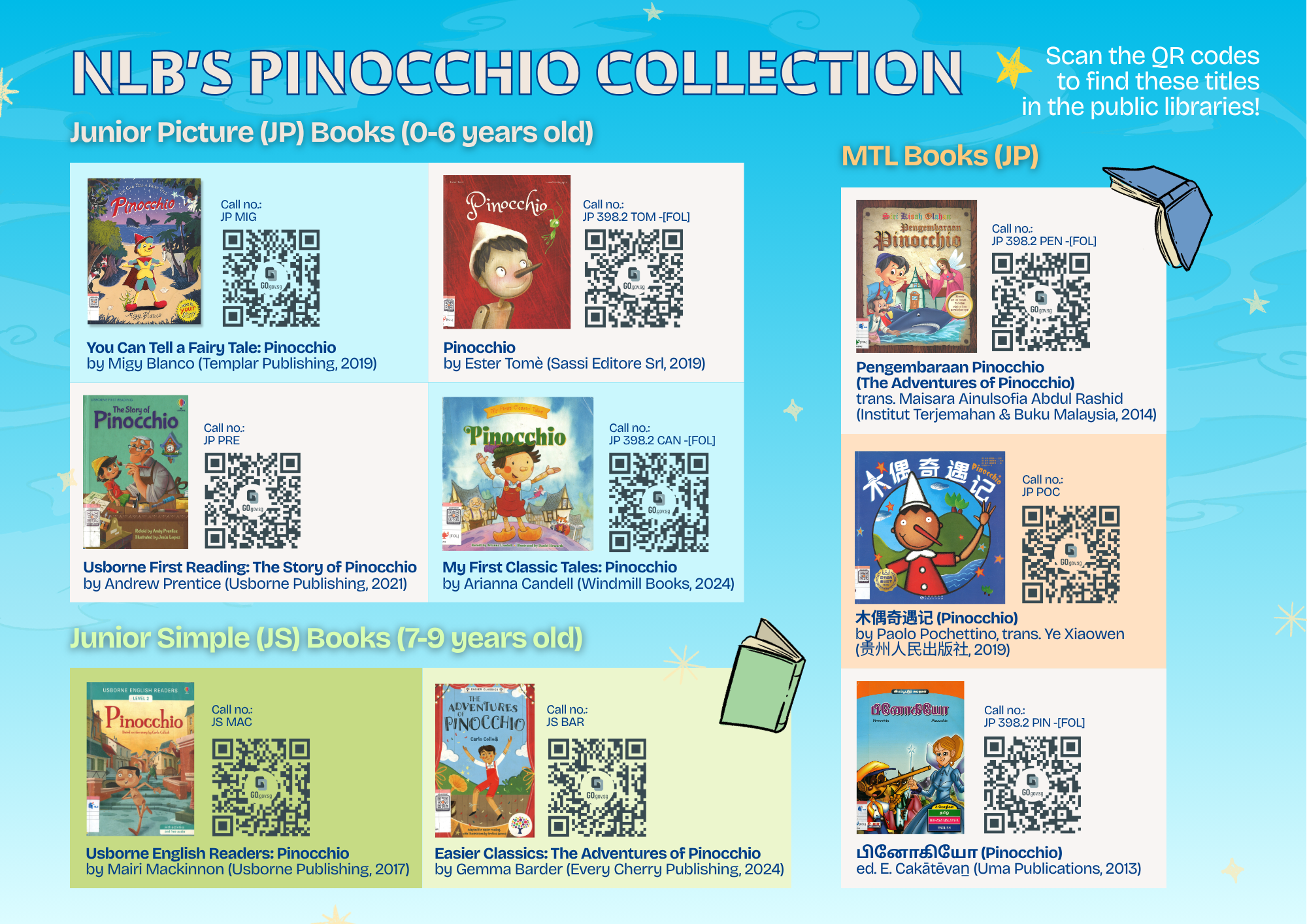
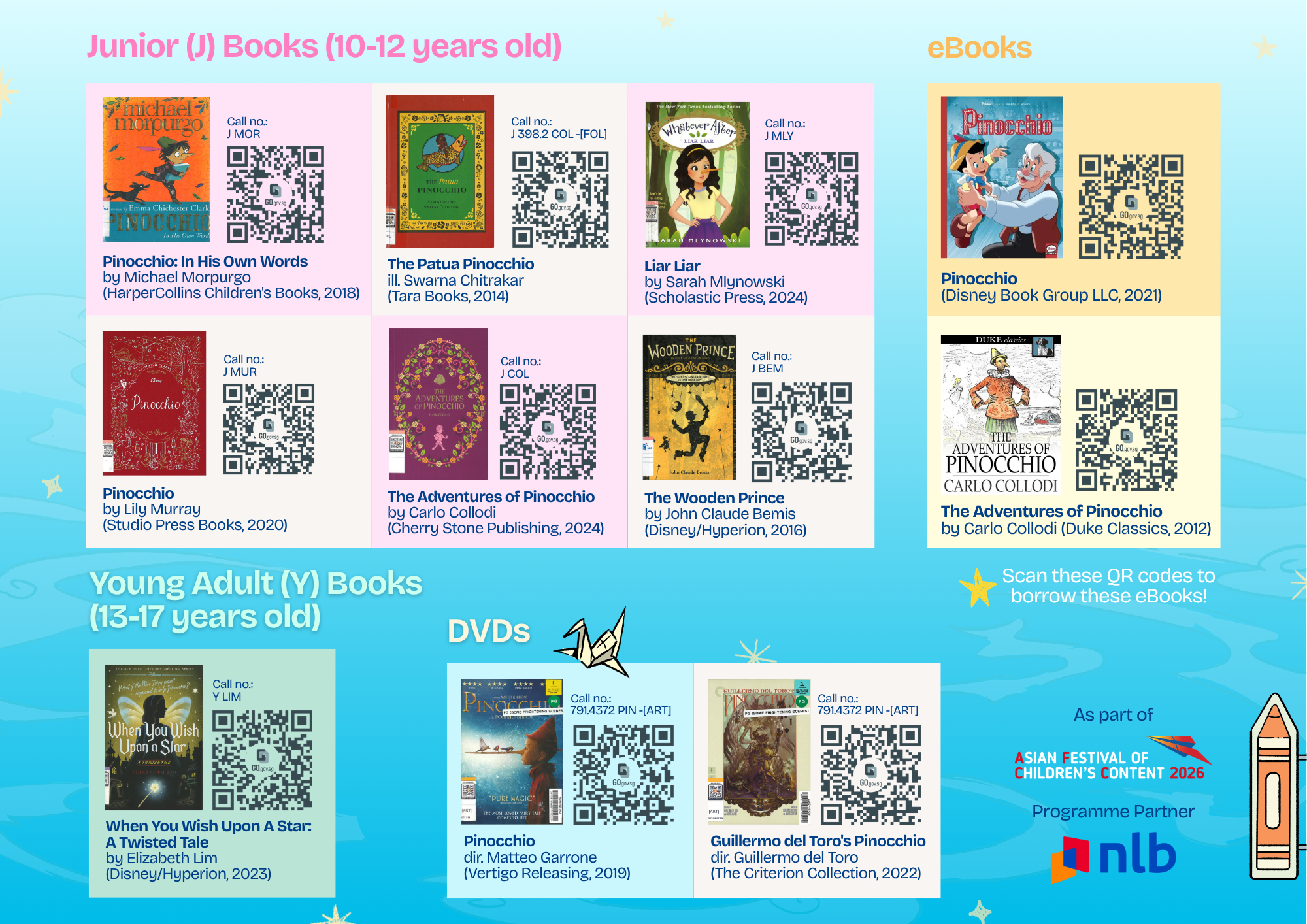
Pinocchio collection at the National Library
LORENZO MATTOTTI
For Lorenzo Mattotti (1954) the encounter with the puppet was thanks to foreign publishers. In France, the extraordinary work of the cartoonist Mattotti was discovered by the historic Albin Michel, whose catalogue already included Attilio Mussino’s famous Pinocchio. In 1985, five young women, founders of the Giannino Stoppani children’s bookshop in Bologna, had asked Mattotti to draw the famous rascal for the bookshop’s logo as well as two other illustrations for the exhibition Doctor Pencil & Mister China. Old Tales, New Illustrators, held at the Galleria d’Arte Moderna in Bologna. Mattotti chose Pinocchio for his ‘old tales’, producing two incredible powerful scenes: Mangiafuoco in the puppet theatre, and Pinocchio hanged. These were enough to get him a contract with Albin Michel, and in 1990, French readers were regaled with a new Pinocchio. That was just the beginning. Interest for Collodi continued in both France and Italy, which led to Pinocchio reaching the big screen. In 1994, the snow scene became the cover of the Bologna Children’s Book Fair Annual. With time, new editions were released with new, much-acclaimed illustrations by Mattotti. Indeed, the artist spent hours at the 2025 Taipei book fair signing the Mandarin edition of the book illustrated by him and released by Locus Publishing, the publisher of Bruno Munari and Gianni Rodari!
Although at the forefront of digital technology, the people of Taiwan seem to have maintained their love of the printed page, especially when showing artistic excellence.
EMANUELE LUZZATI
Emanuele Luzzati (1921-2007) has not yet been sufficiently celebrated or studied in Italy, something our French friends cannot fathom; they would have already produced a huge exhibition in Paris at Le Musée des Arts Décoratifs, next to the Louvre, on the wide and varied career of an artist who, not only a theatre-set and costume designer, learned the art of animated drawing, illustrated a child-friendly Mozart, and brought to life the characters of Gianni Rodari and Italo Calvino as well as classics like Alice and, of course, Pinocchio. In 1981, for the centenary of the first publication of Pinocchio, Emanuele Luzzati and Tonino Conte, together with the Genoa Teatro della Tosse, created a stage in a city square for a shadow theatre that also featured Pinocchio-like figures in the style of Teatro Gioco Vita, a splendid example of Italian children’s theatre in those years of artistic fervour. In the same vein, in the years after 1977, Andrea Pazienza was to design the sets for the restaging in Bologna of the texts of Enrico Novelli, known under the pseudonym of Yambo. Fifteen years after that centenary, Luzzati returned to Pinocchio and a complete edition was published by Nuages.
Engaging with Pinocchio was also an extraordinary artistic journey for Luzzati. In fact, he and Collodi form an artistic duo worthy of study – something that might even come about since celebratory events are opportunities to return, re-read, research and appreciate new aspects of an artist’s work.
ATTILIO CASSINELLI
“I have boundless sympathy and affection for that unfortunate Pinocchio...”
Attilio Cassinelli (1923-2024) worked for over forty years to combine Collodi’s richly-worded prose with his own synthetic, boldly-coloured style. In 1981, he worked on a series of publications with Giunti, the puppet’s elected home, until 2023 when his final Pinocchio was released by the publisher Lapis. This last, albeit beautiful portrayal is of a more subdued, languid puppet that old age has drained of its former energy. Neat and elegant, its white pages setting off the artist’s subtle ink strokes, the publication celebrates Cassinelli’s one hundredth birthday with a painstaking review of his illustrations of Pinocchio published by Giunti in 1991.
The story unfolds like a long novel in pictures, a surprising forerunner of the modern graphic novel. Already with his earlier fairy-tale illustrations, Cassinelli had developed a graphic style that captures the essence of the narrative. In fact, Gallimard’s catalogue description of his fairy tales – published in Germany, Japan, China, Japan, Turkey, and Brazil – confirms that excellence lasts the test of time. The artist’s Pinocchio for children is an extraordinary synthesis of Collodi’s world, introducing young readers to a character whose many, unforgettable adventures they will gradually discover.
TONY WOLF
Every child in Italy, and many other countries besides, has encountered the art of Tony Wolf (1930-2018), the pseudonym given to Antonio Lupatelli by his English friends with whom he worked in London at the beginning of his career, arriving in the country without a word of English.
Wolf’s illustrations are full with gnomes, fairies, giants and characters from the most famous fairy tales. His crowded scenes fascinate and stimulate children whose fresh gaze instinctively appreciates beauty and craftsmanship beyond any definitions of canon or fashion.
Lupatelli continued his apprenticeship under the Pagotto brothers, Nino and Toni, illustrators, cartoonists and later, animators. This indeed may be why Wolf’s illustrations convey a sense of movement so that readers constantly shift their gaze to take in every small detail.
Lupatelli’s Pandi, however, takes its cue from the elementary, linear style of Dick Bruna. The name of this little black and white panda’s, Oda Taro, was invented by his Tokyo publisher. Wolf became a friend of the illustrator Roy Dami, and when Roy’s brother Piero founded the publishing house of the same name, he became the company’s exclusive author, contributing to its success. Dami Editore subsequently came within the fold of the Giunti Group.
As well as Pandi, Pingu became a global success thanks to the animated series. Lupatelli subsequently added another character, also beginning with ‘P’: Pinocchio. For him, the puppet was synonymous with Tuscany, a region which, in his words, created beauty out of very little, citing the art of Ugo Fontana and Tuscan cuisine.
CHRIS McEWAN
In 1990, Mondadori chose the British author Chris McEwan for its new Pinocchio, after Harper Collins had offered him the opportunity to continue working on Italian themes in the wake of his Tuscan fairy tale Cecino. A lover of Italian design - and owner of an Alfa Romeo - McEwan gladly accepted the commission.The book received the highest honours, even earning a mention at the BolognaRagazzi Award that same year.
I remember in 1986, before the French edition, walking around the Italian stands at the Bologna book fair with two Lorenzo Mattotti illustrations that aroused little interest. Compared to Mattotti’s Pinocchio, McEwan’s illustrations seemed easy, simple… too simple. Today, with the hindsight of maturity that has made me less partisan of the Valvoline style, I consider McEwan’s work noteworthy, able to hold the attention of very young readers precisely because of its very special Pop atmosphere. The illustration depicting the fish being pelted with school books is very well done and effective. It would be perfect as the cover of a treatise on today’s school textbooks - that, ideally, should start with those mentioned in Pinocchio, include the opinions of Lambruschini and Ferdinando Tempesti, and conclude with the innovative critical insights of the kind Umberto Eco envisaged as coming out of in-depth research.
SARA FANELLI
Sebastian Walker, founder of the London publishing house Walker Books, and described by Maurice Sendak as a kind of Prospero, left this earth in 1991, the victim of AIDS, but not before bequeathing his beloved creation to his co-workers. In 2003, this director-less publishing house released Sara Fanelli’s (1969) Pinocchio. Fanelli grew up in Florence, where Pinocchio is to be found on every street corner: a giant figure at the entrance to the city’s largest toy shop, small and hardly recognisable on the key rings sold at every souvenir stall. The daughter of an architect father and an art historian mother, Fanelli chose to study in London, where she found a warm welcome for her Pinocchio and as the creator of the New Tate’s visual identity. In the world of international illustration and graphic design, her style of skilfully placed collages combined with excellent graphics together with photographic and typographic inserts is highly appreciated. In 2022, she was invited by MoMA to return to Pinocchio for the conclusion of the exhibition on the making of Guillermo del Toro’s animation film Pinocchio. Using images, postcards and photographs, her From Michelangelo to Guillermo del Toro, invites us to celebrate and keep alive the anarchical spirit of a puppet forced to come to terms with the adult world, a message Fanelli sends to every child in the process of growing up.
The history of publishing is bound up with the history of culture: on the one hand, there are books and stories; on the other, the circumstances that generate them. Today, Walker and its American counterpart Candlewick is Chinese-owned, and a whole new chapter in the story of these companies is about to unfold.
NICOLETTA CECCOLI
Nicoletta Ceccoli (1973), whose magical, fairy-tale style is so popular with Americans, colours her world of puppets in pink, blue and green, continuing a pink period that began with her first works dedicated to Alice - a “maladjusted” Alice, as Gianni Celati called Bologna’s tumultuous student population of the late 1970s. Ceccoli’s Pinocchio was published by Mondadori in 2001. It still bears Ceccoli’s signature pink but with the addition of round, reassuring shapes. A punk girl from the Republic of San Marino, in black leather jackets and green-dyed hair, Ceccoli followed the artistic influences of her time, finding greater favour in America than in Italy. Americans love her ethereal world, which, moving on from punk and pink, became decidedly dark-new wave and later, even more phantasmagorical. Her ability to construct an elegant fantasy in suspended, rarefied atmospheres inhabited by celestial creatures has made Ceccoli popular, not with mass audiences, but with refined New York publishing houses appreciative of this artist’s truly unique artistic ability, never once hinting that she might be “too European”, a criticism levelled at many other artists.
ED YOUNG
The interpretation by Chinese-American Ed Young (1931-2023), winner of the 1990 Caldecott Medal and twice included in the List of Honor Books, is truly unique. Born in China in 1931 and raised in Shanghai during the 1940s, Young arrived in the United States in 1951 to study architecture, but soon began working with images, mainly for advertising agencies, which were very active at the time and on the lookout for talent. An artist of many talents, and technical skills, Young’s Chinese background made him an expert in inks, brushes and, above all, paper, a highly prized medium in Chinese culture. In fact, many children’s books still tell the story of how paper was invented, used and sold, and much of children’s publishing still relies on paper figures and cards to illustrate stories. Pinocchio is also made of wood — another material dear to China, celebrated by Ai Weiwei in recent exhibitions — that calls on paper in all its infinite possibilities: just one colour, transparent, rich in nuances, ready to be shaped with scissors into a silhouette or assembled for a collage. In 1996, Ed Young’s tribute to Collodi’s character was published by Philomel, an imprint of Penguin Books USA that has always maintained a degree of independence and encouraged research. Ed Young must have studied Italian art in depth since it is unlikely that he could have found those pinks and blues to frame the puppet’s face in profile on the cover in the manner of Renaissance portraits.
KęSTUTIS KASPARAVIčIUS
1993 saw the publication of an illustrated adaptation by Kęstutis Kasparavičius (1954), a Lithuanian artist known worldwide for his skilful use of watercolours and the surreal, humorous yet poetic spirit of his stories populated by bears, pigs, rabbits and turtles, who all find themselves in strange situations. Strangeness is Kasparavičius’ trademark. His spirit and style have a wide following; his books are found in bookshops in over thirty countries and he has been selected several times for the Illustrators Exhibition in Bologna. Although his Pinocchio is portrayed in the most well-known episodes, Kasparavičius also reserves surprises for readers, such as the image of the puppet hanging by his fee from the oak tree like the Hanged Man in a tarot pack, the Major Arcana card signifying a state of suspension before a change in perspective takes place. Pinocchio does not die but comes close to it:
“Little by little, his eyes clouded over; and although
he felt death approaching, he still hoped that
at any moment some compassionate soul would
come to his aid.”
Fortunately, a beautiful blue-haired girl performs a magic trick. With three claps of her hands, as befits a fairy, she “commands” the falcon to break the knot with its beak. The Hanged Man is saved and the adventures can continue.
GUIDO SCARABOTTOLO
In 2010, Andrea Rauch (1948 - 2025) wrote his own version of Pinocchio for his publishing house Principi & Princípi, his narrative skill capturing the essence of Collodi’s style, as in the following passage:
“I have met a whole family of Pinocchios: Pinocchio the father, Pinocchio the mother, Pinocchio the children, all in fine fettle.”
The illustrations were entrusted to Guido Scarabottolo (1947) who, as usual, played masterfully with lines to create incisive, soberly elegant illustrations. Very probably, Scarabottolo also decided on every aspect of the book, assembling page after page, choosing colours and fonts, and demonstrating the importance of what in publishing we call the ‘book designer’. A work of great intelligence, taste and graphic skill paying tribute to a priceless cultural treasure that Gallucci did well to republish in 2016. Scarabottolo’s achieves a perfect amalgam of carefully planned lines and “scribble”, the uncluttered pages making the few objects stand out and tell the story.
Unlike the bright Green Fisherman of other illustrators, Scarabottolo’s is as evanescent as the wisp of smoke rising from the cooking pot. Drama is portrayed with subtlety, a seeming oxymoron; a metaphor rendered with a mere stroke of the pen.
VITTORIA FACCHINI
At the beginning of the new millennium, Vittoria Facchini (1969), already an established artist with books published in France and shortly afterwards in the USA, was working on a Pinocchio-themed text published in the 1980s. At her disposal were two-colour prints and the truly original theatrical text by Luigi Compagnone (1915-1998), journalist, writer, poet and playwright. Compagnone defined his work as a rhymed comic-opera libretto on the adventures of Pinocchio. As illustrator, set and costume designer, Facchini generously contributed creative suggestions, for example, giving the carabiniere a Zorro-black costume. Her Pinocchio is a little devil, with an ink-black body, red horns and trident. It is this mischievous little devil who talks back to the Cricket:
Sing on, my cricket,
As you please.
But tomorrow I’m away
Whatever you say
For, were I to stay
It would mean school
And obeying the rule.
A puppet with horns and a trident harks back to pagan myth and medieval iconography, recalls Poseidon’s trident, or even perhaps a farm labourer’s pitchfork. Facchini’s colours are strictly red: the red of hell and blood. Little surprise that this devil defies the cricket’s advice and responds by throwing a hammer.
Cri - cri - cri
I didn’t think it would end like this.
But after the crime, the little devil just feels hungry.
Today, we have lost the freedom to write and illustrate such scenes.
FERENC PINTÉR
Ferenc Pintér (1931-2008) was born in Alassio to an Italian mother and Hungarian father. At the age of nine, the family moved to Budapest where his father, a painter, died of tuberculosis. Not accepted by the Budapest Academy of Fine Arts for political reasons, in 1956, following the Soviet invasion, Pintér managed to leave the country and go to Milan. There, he found work thanks to his artistic skills, joining Mondadori in 1960 where he worked for over thirty years, drawing and painting with great success. He illustrated the covers of the detective stories in the Omnibus and Oscar collections, among them George Simenon’s Chief Inspector Maigret. Pintér also produced covers for the novels by great writers like Cesare Pavese and Grazia Deledda. His Pinocchio came at the end of his career when he produced a total of forty-eight illustrations that were posthumously published by Lo Scarabeo in 2011. A few years earlier, in 2003, Segni & Disegni had published ninety copies of eight numbered and signed works. Pintér’s medium was tempera. Cover designers should be recognized for their specificity or hability. Alongside Pintér’s work, we also remember that of the great Karel Thole.
SWARNA CHITRAKAR
The idea of a Pinocchio in Patua – an Indian artform combining painting, storytelling and performance - was first mooted in 2013 during a Tara Books artist workshop in Bengal.
One of the artists present, Swarna Chitrakar, a well-known artist of some twenty years’ experience, chose the figure of Pinocchio. In her view, Pinocchio has much in common with the popular Hindu god Krishna: part rascal, part saint. The group also considered how the characters should be dressed. The Blue-Haired Fairy wears an Indian sari, for example, like many women in rural areas, however, her bejewelled hair is a sign of her higher status; both housewife and goddess, she is like the mother of the little Krishna. Patua artists specialise in portraying animals, especially birds. Swarna also added many fish, as well as a beautiful shark. This Pinocchio was a process involving several artists, the publisher, and book designer Tanuja Ramani. Published in 2014, it contains aspects reminiscent of late 19th-century graphic and typographic art.
This was the first time that a children’s classic from another culture was chosen for this type of Indian art. We owe a great debt of gratitude to Gita Wolf, the world-renowned Indian publisher, winner of the 2013 BOP, The Bologna Prize for Best Children’s Publisher of the Year (Asia), and a leading figure in world publishing. Her books are truly cultural crossroads, giving us Westerners an opportunity to understand India’s far-reaching cultural roots.
Patua Pinocchio is in English, an official language of India.
ALESSANDRO SANNA
We do not know how long Alessandro Sanna (1975) thought about illustrating Pinocchio before 2015 when his version of the puppet was published by Orecchio Acerbo. The following year, the book was in American bookshops, Sanna being already a great favourite after his masterpiece The River, dedicated to the river Po. His approach to Collodi is unique and authorial, a poetic account of the puppet’s cosmic origins. In Prima di Pinocchio, the puppet is no mere stick of wood, but the result of the force of nature and the elements: a tree, a branch, a stick that breaks off and comes to life. The adventure begins and the story unfolds from image to image offering an unusual take on a simple yet complex character familiar to all but whose story not everyone has read. Ten years on, Alessandro Sanna’s work has further matured. As an artist, he keeps many doors open. He continues to explore new worlds while working in synch with clients’ needs. American publishers are fully aware that Sanna is also able to tackle the entire adventures of the puppet, just as Carlo Collodi delivered them to the world. Indeed, like a humble craftsman, he has set to work and, in time, will deliver his completed cathedral. It will be made up of illustrations never before seen, perhaps resonating with echoes of those that have come before. His version of Pinocchio’s beginnings gives us a preview of what to expect.
PHILIP GIORDANO
Of Asian descent on his father’s side, Philip Giordano (1980) spent several years in Tokyo where he developed a love of Japanese culture and the visual arts; the animation film company Studio Ghibli was a key point of reference. In Italy, he has worked with leading publishing professionals like the Debbie Bibo Agency and Topipittori. Giordano chose the pop-up book format for his Pinocchio, creating a book-game co-published by Nexquisite and Mondadori in 2022, and then in the USA in 2025 by the American publishing house, Tra Publishing, founded in Miami by the Swiss designer Ilona Oppenheim in 2016. Gifted with flair, taste and style, Oppenheimer seeks out talented young artists, choosing Giordano’s short pop-up for its well-illustrated, well-constructed pages. Readers enter a Puppet Theatre – more a game than a book - where they meet The Fairy with the Blue Hair, the Cat and the Fox, and the Talking Cricket, and finally see the metamorphosis of the mischievous puppet into a boy. They understand they are witnessing something completely bizarre, a story devoid of didactic undertones with many characters and as many twists and turns. Every page presents a new surprise, making the game of reading, listening and watching truly enjoyable. The illustrations are beautifully crafted, referencing the sharp, colourful world of Italian Futurism, in the manner of Fortunato Depero, but rendered in a softer, less angular style, more akin to animated drawings. Giordano’s most successful illustration is of the puppets - a favourite Futurist subject - delivered here in gentler tones and forms.
CHRUDOŠ VALOUŠEK
Linocut is one of the many techniques used to depict the puppet. In his famous essay entitled La via della sgorbia (Using the Gouge), Antonio Faeti recounts his experience as a young orphanage primary school teacher showing a class of boys the linocut technique to help them develop artistic expression. Very poor and without access to the right materials, the kids improvised with whatever material they could find: cardboard, plastic etc. By the same token, today’s children could be introduced to the work of Chrudoš Valoušek (1960), a Czech artist, winner of the BolognaRagazzi Award in 2019 for his Pinocchio. A truly independent artist and experimenter, Valoušek has little time for awards, whether domestic or international, saying they do not change his life except to help him get better fees from publishers. Although carved from wood, Valoušek’s puppet does not follow Collodi’s text but is still a symbol of free, unfettered imagination and the overturning of norms. The extraordinary graphic and typographic design of this large-format book is a work of art. Unmindful of the market, it invites readers, young and old, to consider or reconsider the power of the page. Every detail is carefully planned. Every square centimetre of the cover, back cover, endpapers and openings is a tribute to the art of bookmaking.
JUSTINE BRAX
French artist Benjamin Lacombe leads an artistic movement that revisits children’s literature classics introducing fantastical figures. Just over forty, Benjamin Lacombe is already the author of numerous successes, with millions of copies sold worldwide. Ever since his student days at ENSAD, the École nationale supérieure des arts décoratifs in Paris, the illustration world has been fluorescent and digitalised. However, this young artist looked to classic Italian and Flemish painting but also the visual experiments of movie directors like Tim Burton and Wes Anderson in search of his own style, very clearly finding it. In his early forties and already a very popular artist - to the tune of millions of copies - Albin Michel, publisher first of Attilio Mussino’s and then Lorenzo Mattotti’s Pinocchio, entrusted to him as author and curator of a special series that included other like-minded illustrators. Justine Brax, who also graduated from ENSAD in 2005 where she now teaches, was chosen to illustrate the puppet’s adventures. Interestingly, Pinocchio has seldom been illustrated by a woman, as can be seen from this brief visual history. Perhaps Lisbeth Zwerger would have liked Brax’s rendering. She herself included an illustration depicting Pinocchio in the company of the Cat and the Fox at her exhibition in Bologna in 1989. The dark side of this Viennese artist was already apparent in her Hansel and Gretel and in the atmosphere of Hoffmann’s tales can also be seen in her Collodi. Justine Brax, on the other hand, depicts a world of softer tones in the manner of Lacombe. Her atmospheres are luminous even when the scene is enveloped in darkness.
MINALIMA
Following the popularity of their Harry Potter film saga, the London-based studio MinaLima Design, founded by Miraphora Mina (1965) and Eduardo Lima (1974), launched the MinaLima Classics project, a series of interactive classics. These include The Wizard of Oz, The Jungle Book, Alice, Peter Pan, classic fairy tales, and Pinocchio. The studio’s signature style is a combination of nineteenth century publishing traditions and modern paper engineering technology. Their work harks back to the French Hetzel and Victorian publishers produced, however, with digital technology. Like many of his generation, Edoardo Lima was not familiar with the long visual history of Pinocchio, explaining that as a child, he saw the Disney film that omits accounts of the terrible things the puppet endures; and on seeing a Japanese version, he cried so much that his parents never let him view it again. Later on, however, Lima read the book and fell in love with the story.
For many different generations, Disney was their introduction to Pinocchio. The bicentenary of Collodi’s birth will hopefully encourage a return to the text and to manmade ways of developing “new clothes”, to quote the title of the Exhibition. Hopefully too, as in Andersen’s tale, innocence will call out the nakedness of visual technology.
MARCELLO JORI
In 2018, Marcello Jori created a handwritten, illustrated version (in Italian) of The Adventures of Pinocchio for an exhibition at Modena’s Mazzoli Gallery. This three-volume, hand-bound edition came about thanks to gallery director Emilio Mazzoli’s great love of the tale whose illustrated editions he collects. 500 numbered copies were printed for the exhibition while the bookstore edition was published in 2019 by Mondadori Electa under a Rizzoli imprint.
Jori himself calls it a “monumental work”, outside the realm of a traditional illustrated book where text and images invariably proceed together. For this volume, Jori first transcribed the words, subsequently moving on to shapes, colours and materials, a process that allowed him to absorb the tale and, in the words of Daniela Marcheschi, “see the page as a space”.
If first transcribing, then creating images in the manner of a Renaissance artist, Jori took the puppet beyond the confines of the printed book, it was again, like an artist of the past that he created a four-metre-tall bronze Pinocchio, placed in the centre of Piazza Mercato in Naples in 2025 for the enjoyment of Neapolitans, young and old alike. Entitled Oh! - an interjection we use to express many emotions – it echoes the amazement and enthusiasm of a puppet created out of a stick of wood as he views the world he can now inhabit.
IACOPO BRUNO
Known throughout the publishing world, Iacopo Bruno (1964) is an illustrator, graphic designer, art director, and visual craftsman of books. His illustrations have been acclaimed by authoritative organisations and events like Bologna Children’s Book Fair and the Society of Illustrators in New York. Together with his wife, Francesca Leoneschi - a former co-worker at Mucca Design, the New York studio founded by Matteo Bologna - Bruno created the studio The World of DOT. The studio’s style soon won over many publishing houses seeking a highly recognisable product: elegant, a touch vintage and graphics that are as important as the illustration. Subsequently, Bruno’s illustrator’s soul came to the fore and his illustrated series of the classics, one of which Pinocchio, was published by Rizzoli. The book covers for this collection of classics depart from the style of his previous work, since both the stories and their characters required extension rather than extreme synthesis. The result is covers reminiscent of a previous book-making era. The portrait of the author opens each volume, followed by a few lines of the first chapter and then the first illustration, first in red chalk, then in colour, and so on, before arriving at a full-page illustration. I call the red pencil “red chalk” deliberately referring to the great masters of the past. My favourites are those by Guercino, just as my favourite section of Bruno’s book is the illustrated section that plays with the constituent elements of illustration: sketches, proofs, drawings, and colour. Bruno’s Pinocchio will resonate especially with children who love to draw and try their hand at a character, developing at an early age that hand-brain connection which, even in this new digital age, remains the basis of artistic creation.
ALBERTO GAMÓN
The Spanish Las aventuras de Pinocho, published in 2024 by Nørdicalibros, is a true gem. The paper, graphics, illustrations, format and cloth blend to create a harmonious, tasteful and soberly elegant whole. Alberto Gamón (1974) works for both children and adults. His acknowledgements on the last page read:
“Carlo Collodi was clear that everything was a problem of poverty and a lack of education. I dedicate my work in this book to my teachers – those who are no longer with us and those you are - who enriched my journey. They are always with me.”
Gamon’s Pinocchio pays homage to art, architecture and Florence. He notes how the wood Pinocchio is made is a perfect colour match with Brunelleschi’s stone; how Carducci’s cypress trees and bunches of grapes are an ever-present feature of the landscape; as are the zecchini, or gold coins, gifted by the generous Mangiafuoco only to be stolen by the pair of swindlers. Throughout the book, it is evident that Gamon’s illustrations are the result of much study, research and documentation. A clear example is the inclusion on Geppetto’s crowded workbench of the front page of Il lampione, the satirical newspaper founded by Carlo Lorenzini in 1848 with the intent, he wrote, of shedding light for those who grope in the dark, in other words, not only fellow intellectuals, but the general public.
GABRIEL PACHECO
In 2024, the publisher Logos commissioned a wordless - or silent Pinocchio, as we Italians have learned to call it - by the Mexican artist Gabriel Pacheco (1973). The first smoky grey pages place the wooden puppet in the muted, poverty-stricken world into which he was born: a cold carpenter’s workshop where the carefully aligned tools seem laid out as if dead. Sadness pervades Pacheco’s story, relieved only by Bruegel-like village scenes of children playing. Pacheco has created a book that requires in-depth knowledge of the full story, including Collodi’s actual words. It is a useful exercise to help fix in children’s minds the vicissitudes of a character in a tale Collodi himself described as a story for children but which in fact poses questions still pertinent today. Pacheco’s puppet reminds us of the universally known Commedia dell’Arte character, Pierrot. His silent Pinocchio, where everything is entrusted to the visual, also presents an unspoken challenge since looking without understanding is to be blind. Yet, if we listen to Colledi, eyes half closed, as children do when listening to a story before falling asleep, we will comprehend every interpretation, whether written or just illustrated.
CARLL CNEUT
The great children’s writer Imme Dros (1936) gave Dutch children a work that pays tribute to Carlo Collodi with a rewriting of Pinocchio for the publisher Querido, the most important Dutch publisher of children’s books, now working in association with a US firm and publishing under the name Levine Querido. Given the importance of this new tribute to Collodi, Levine-Querido entrusted Carll Cneut (1969) with the illustrations – a highly appropriate choice, proving yet again that quality seeks out quality, and that those destined to become a classic of their genre will be chosen to illustrate a literary classic, thereby maintaining high standards, preserving tradition yet guaranteeing innovation. Born in Belgium in 1969, Cneut attended the Ghent Institute of Fine Arts and worked as an advertising agency art director before moving to books, writing and illustration. Internationally acclaimed right from the start, his highly personal, pictorial style and use of acrylic colours regales us with either intensely dark or luminous scenes. Cneut has illustrated poems by Carl Norac, and narratives by Roberto Piumini, Toon Tellegen, and Geert De Kockere. Two hundred years after Collodi’s birth, his puppet now inhabits a world lying between Flanders and Holland, to the great satisfaction of we Italians!
ROBERT INGPEN
Australian Robert Ingpen (1936) received the prestigious Hans Christian Andersen Prize in 1986 for his work as an illustrator. Given his enormous body of work, the award seemed more like a lifetime achievement award. However, at the turn of the new century, Ingpen undertook a review of the all-time classics of children’s literature: Jules Verne, J. M. Barrie, Robert Louis Stevenson, Hans Christian Andersen, Rudyard Kipling, Kenneth Grahame, Charles Dickens, Mark Twain, Lewis Carroll, Frances Hodgson Burnett, L. Frank Baum, and Edward Lear, every year producing a new title. In 2014, it was the turn of Collodi, completing a splendid Bildung of authors and their works to support any young reader’s journey through the world. Ingpen has used paper, watercolour, and tempera for over forty years, mixing other liquids – usually egg – with his colours. For artists who love their craft, drawing and painting in the service of great writers is a great privilege. Ingpen’s mastery has been celebrated with awards and exhibitions from Bologna to Taipei. Hailing from the coastal Australian city of Geelong - Shau Tan’s home town - surrounded by unspoilt landscapes and Aboriginal history, Ingpen perfected his skills at the Royal Melbourne Institute of Technology, where he learned to blend science and design.
PETER BAILEY
Peter Bailey (1946) attended Brighton College of Art, where he was privileged to have teachers like Raymond Briggs, John Lawrence and Justin Todd, to name but a few. He has worked with great authors like Philip Pullman, and poets like Carol Ann Duffy, and Tony Mitton. Bailey has devoted much of his time to teaching in the north of Britain, more specifically in Liverpool. He is part of the Children’s Books North Network, bringing together many authors and illustrators living in the north of the country to promote good books and organise exhibitions, events and awards. Illustrations for children have been a British speciality since the beginning of children’s publishing, the quintessential British style recognisable in periodicals and children’s books. Artists range from William Hogarth down to Quentin Blake, and from Ernest Howard Shepard to Chris Riddell. Bailey is a direct descendant of Shepard, the illustrator of all the Winnie-the-Pooh characters. His Pinocchio, published in 2023 by Alma, a London-based publishing house founded by Italians, is a total joy. Eschewing current trends and market dynamics, this graceful, elegant black and white edition seems to tell us that beauty is in the little things, but that understanding requires awareness. The illustrations open each chapter rather than accompany the text. They show the reader what they do not yet know and will discover as they read. Small and masterfully crafted, they are the work of one of the masters of our time, an amalgam of artistic skill, learning and good taste.
MIKE MIGNOLA
Walt Disney (1901-1966) turned his attention to Carlo Lorenzini’s Pinocchio in the 1930s. After Snow White and the Seven Dwarfs, it was Italy’s turn with Collodi’s memorable opening:
“Once upon a time there was...
“A king!” - my little readers will say at once.
No, my dears, you are wrong. Once upon a time
there was a stick of wood.”
This stick of wood embodied rebellion, escape, a desire to have fun, and a dislike of talking crickets - unpalatable traits for America, so Pinocchio became what he still is for many, Americans and non-Americans alike: not a bad character, but very far from the original stick of wood.
Collodi’s stick was revisited in 2002 by a great contemporary American author and illustrator, Lane Smith (1959), who followed the puppet from when he becomes a child. Pinocchio the Boy was also published in France by Seuil, in those years the producer of truly extraordinary and unusual books. Smith’s splendid illustrations, arranged by his book designer wife, the extraordinary Molly Leach, tell the story of Pinocchio after he is turned into a boy in his sleep by the Blue Fairy, who, however, forgets to tell him about his past as a wooden puppet. Disney Productions obviously also appreciated Lane Smith, entrusting him with James and the Giant Peach. However, both their Pinocchios have little in common with Collodi’s character.
It was not until 2025 that a great illustrator, Mike Mignola (1960), a giant of the American comic book, author of Hellboy, rendered Collodi’s text with powerful graphic illustrations. A great lover of Pinocchio, Mignola’s superb illustrations are a fitting contribution to Collodi’s bicentenary!
WOLFANGO
As the great Carlo Dionisotti (1908-1998), literary critic, philologist and historian of literature, reminded us in his commentary to mark the sixth centenary of Dante’s death in 1921, we create secular calendars when we celebrate centenaries, bicentenaries or millennia, a tradition that continues with the European Year of the Romans in 2027. The 1921 Dante centenary, the first to be celebrated after Italy’s unification, was a very nationalistic affair and hailed the poet as the apotheosis of Italian genius. These few notes on some of the illustrators of Pinocchio to mark the bicentenary of Collodi’s birth close with a tribute to a Bolognese artist born a hundred years: Wolfango. A painter of large canvases, he did not disdain the cramped space of the book. Winner of the first BolognaRagazzi Award in 1996, Wolfango concealed his true identity as has often been the case in the history of painting, calling himself ‘Anonymous Bolognese’. He later took the pseudonym ‘Golpe’. The illustrations of Pinocchio by Wolfango Peretti Poggi (1926-2017) were published by Banca dell’Etruria in 1981.